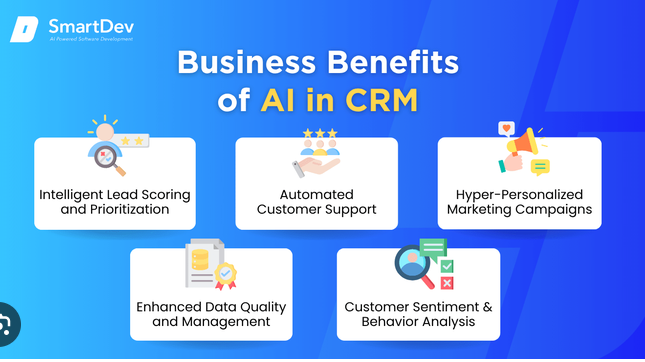
Artificial Intelligence (AI) has transformed the way businesses manage customer relationships. Traditional Customer Relationship Management (CRM) systems primarily served as digital databases where businesses stored customer information, tracked interactions, and managed sales pipelines. Today, AI-powered CRM software has evolved into a smart business assistant capable of predicting customer behaviour, identifying high-quality leads, automating repetitive tasks, and improving customer retention.
Businesses across industries are increasingly adopting AI-driven CRM solutions because they help sales, marketing, and customer service teams make better decisions based on real-time data. Instead of relying solely on manual processes and assumptions, organizations can leverage machine learning, predictive analytics, natural language processing, and intelligent automation to improve productivity and customer satisfaction.
Lead generation and customer retention remain two of the biggest challenges for modern businesses. Finding qualified prospects requires analysing vast amounts of customer data, while retaining existing customers demands personalized experiences and proactive engagement. AI-powered CRM software addresses both challenges by delivering intelligent insights that enable businesses to attract the right customers and maintain long-term relationships.
This article explores the top benefits of using AI in CRM software for lead generation and customer retention while explaining how businesses can leverage AI to achieve sustainable growth.
Understanding AI-Powered CRM Software
AI-powered CRM combines traditional customer relationship management features with advanced artificial intelligence technologies. Instead of merely storing customer information, AI analyses customer behaviour, predicts future actions, and automates decision-making processes.
An AI CRM system typically includes features such as:
- Predictive analytics
- Lead scoring
- Sales forecasting
- Chatbots
- Automated email campaigns
- Customer sentiment analysis
- Workflow automation
- Personalized recommendations
- Intelligent reporting
- Natural language processing
These features work together to create a smarter customer management system that continuously learns from customer interactions.
Why AI Matters in Lead Generation
Lead generation has become increasingly competitive. Customers interact with businesses through websites, social media, email, mobile apps, online advertisements, and search engines. Managing these touchpoints manually can be overwhelming.
AI simplifies lead generation by collecting, analysing, and interpreting customer data from multiple sources. It identifies which prospects are most likely to become paying customers and recommends the best approach for engaging them.
This significantly improves marketing ROI while reducing wasted effort on unqualified leads.
1. Intelligent Lead Scoring
One of the biggest advantages of AI in CRM software is intelligent lead scoring.
Traditional lead scoring often relies on manually assigned points based on limited criteria such as:
- Company size
- Job title
- Website visits
- Email opens
AI goes much further by analysing hundreds of variables simultaneously.
It evaluates factors including:
- Purchase history
- Browsing behaviour
- Social media engagement
- Previous communications
- Product interests
- Response times
- Demographic information
- Industry trends
AI then ranks leads according to their likelihood of converting into customers.
Benefits include:
- Higher conversion rates
- Better sales prioritization
- Reduced manual effort
- Improved sales productivity
Sales representatives can focus their attention on high-value opportunities instead of chasing every prospect equally.
2. Predictive Analytics for Better Decision Making
Predictive analytics enables businesses to forecast customer behaviour before it happens.
AI analyses historical customer data to predict:
- Which leads are likely to convert
- Which customers may leave
- Future purchasing patterns
- Revenue forecasts
- Customer lifetime value
These predictions help organizations make proactive business decisions rather than reacting after opportunities are lost.
For example, if AI predicts a customer may stop using a service, the company can launch a retention campaign before the customer leaves.
3. Personalized Customer Experiences
Modern customers expect personalized experiences.
AI-powered CRM software analyses customer preferences to deliver tailored recommendations, including:
- Personalized emails
- Product suggestions
- Special offers
- Content recommendations
- Follow-up messages
Instead of sending identical marketing campaigns to thousands of customers, AI ensures every customer receives relevant communication based on individual behaviour.
Personalization increases:
- Customer satisfaction
- Email open rates
- Click-through rates
- Conversion rates
- Customer loyalty
4. Automated Lead Nurturing
Not every lead is ready to purchase immediately.
AI automates lead nurturing through:
- Email sequences
- Educational content
- Product recommendations
- Follow-up reminders
- Event invitations
The CRM monitors customer engagement and automatically adjusts communication based on user behaviour.
For example:
If a prospect downloads a product guide but does not request a demo, AI may automatically send:
- Case studies
- Customer testimonials
- Pricing information
- Free trial offers
This keeps prospects engaged without requiring constant manual intervention.
5. Enhanced Sales Forecasting
Accurate sales forecasting is essential for business planning.
AI analyses:
- Previous sales
- Seasonal trends
- Customer demand
- Sales pipeline health
- Market behaviour
Instead of relying on estimates, businesses receive data-driven sales predictions.
Benefits include:
- Better inventory planning
- Improved budgeting
- Smarter hiring decisions
- Accurate revenue forecasting
Sales managers gain greater visibility into future performance.
6. Faster Customer Response Times
Customers expect immediate responses.
AI-powered CRM software often includes chatbots and virtual assistants capable of:
- Answering common questions
- Scheduling appointments
- Providing product information
- Creating support tickets
- Collecting lead information
These AI assistants operate 24/7 without human intervention.
Benefits include:
- Reduced waiting times
- Higher customer satisfaction
- More captured leads
- Lower support costs
Even outside business hours, businesses continue engaging with potential customers.
7. Improved Customer Segmentation
Customer segmentation allows businesses to divide customers into meaningful groups.
AI automatically segments customers based on:
- Purchase behaviour
- Geographic location
- Interests
- Spending habits
- Product preferences
- Customer lifetime value
Instead of manually creating segments, AI continuously updates customer groups as behaviours change.
This enables highly targeted marketing campaigns with greater relevance.
8. Better Customer Retention
Acquiring new customers is significantly more expensive than retaining existing ones.
AI helps retain customers by identifying early warning signs of churn.
It monitors indicators such as:
- Reduced purchases
- Lower engagement
- Negative feedback
- Increased complaints
- Declining website activity
Once risk is detected, AI recommends retention strategies like:
- Discount offers
- Loyalty rewards
- Personalized emails
- Customer success calls
- Product recommendations
This proactive approach improves long-term customer relationships.
9. Predicting Customer Churn
Customer churn prediction is one of AI’s most valuable capabilities.
Machine learning identifies patterns shared by customers who previously stopped buying.
The CRM alerts sales or customer success teams before valuable customers leave.
Businesses can then intervene through:
- Personalized outreach
- Exclusive promotions
- Problem resolution
- Customer education
Reducing churn significantly increases profitability.
10. Smarter Marketing Campaigns
AI improves marketing performance by analysing campaign results in real time.
It identifies:
- Best-performing advertisements
- Most effective email subject lines
- High-converting audiences
- Ideal posting times
- Customer interests
Marketing teams can optimize campaigns continuously rather than waiting until campaigns finish.
This leads to:
- Better ROI
- Lower advertising costs
- Higher engagement
- Increased conversions
11. Workflow Automation
Many CRM tasks are repetitive.
Examples include:
- Data entry
- Appointment scheduling
- Follow-up emails
- Meeting reminders
- Lead assignment
- Status updates
AI automates these tasks, allowing employees to focus on strategic work.
Automation improves:
- Productivity
- Accuracy
- Employee satisfaction
- Operational efficiency
12. Improved Data Accuracy
Manual data entry often introduces errors.
AI automatically:
- Detects duplicate records
- Corrects formatting inconsistencies
- Updates customer profiles
- Verifies contact information
- Cleans outdated data
Clean data results in better reporting and more reliable decision-making.
13. Real-Time Business Insights
AI continuously analyses CRM data and generates insights instantly.
Managers can monitor:
- Sales performance
- Marketing effectiveness
- Customer engagement
- Revenue growth
- Pipeline health
Real-time dashboards allow businesses to identify problems early and respond quickly.
14. Better Customer Service
Customer support teams benefit significantly from AI-powered CRM systems.
AI assists agents by providing:
- Customer history
- Previous purchases
- Recent conversations
- Suggested responses
- Knowledge base recommendations
Agents spend less time searching for information and more time solving customer issues.
This improves:
- First-contact resolution
- Customer satisfaction
- Support efficiency
15. Intelligent Email Marketing
Email remains one of the most effective marketing channels.
AI enhances email marketing by determining:
- Best sending times
- Personalized subject lines
- Relevant content
- Customer preferences
- Engagement likelihood
The CRM continuously learns which emails perform best and automatically improves future campaigns.
16. Increased Customer Lifetime Value
Customer Lifetime Value (CLV) measures the total revenue generated from a customer over the duration of their relationship with a business.
AI helps increase CLV through:
- Cross-selling
- Upselling
- Personalized recommendations
- Loyalty campaigns
- Timely follow-ups
Customers who receive relevant offers tend to spend more over time.
17. Better Sales Team Productivity
Sales professionals spend a significant portion of their day on administrative work.
AI reduces this burden by automating:
- Meeting scheduling
- Call logging
- Contact updates
- Reminder creation
- Sales reporting
Sales teams gain more time to:
- Build relationships
- Close deals
- Generate revenue
18. Voice and Conversation Analysis
Some advanced CRM platforms use AI to analyse sales calls.
AI evaluates:
- Customer sentiment
- Speaking pace
- Frequently asked questions
- Objections
- Buying signals
Managers can coach sales teams using real customer interactions rather than assumptions.
19. Continuous Learning
Unlike traditional software, AI continuously improves.
As more customer data becomes available, AI becomes increasingly accurate at:
- Predicting customer behaviour
- Recommending products
- Identifying opportunities
- Detecting risks
This continuous learning provides businesses with an ongoing competitive advantage.
20. Competitive Advantage
Companies using AI-powered CRM software often outperform competitors because they:
- Respond faster
- Personalize communication
- Close more sales
- Retain more customers
- Reduce operational costs
AI enables businesses to deliver superior customer experiences while operating more efficiently.
Best Practices for Implementing AI in CRM
To maximize the benefits of AI-powered CRM software, businesses should follow these best practices:
Start with Clean Data
AI performs best when customer data is accurate, complete, and up to date. Regularly clean duplicate records and remove outdated information.
Define Clear Business Goals
Identify specific objectives such as improving lead conversion, reducing customer churn, or increasing sales productivity before implementing AI.
Train Employees
Provide comprehensive training so sales, marketing, and support teams understand how to use AI insights effectively.
Integrate Multiple Data Sources
Connect websites, email platforms, social media channels, customer support systems, and marketing tools to create a unified customer view.
Monitor AI Performance
Review AI recommendations regularly and refine workflows as business needs evolve.
Protect Customer Privacy
Ensure compliance with data privacy regulations by handling customer information responsibly and maintaining strong security measures.
Challenges of AI in CRM
While AI offers numerous benefits, businesses should also be aware of potential challenges:
- Initial implementation costs
- Data privacy concerns
- Integration with legacy systems
- Employee resistance to change
- Dependence on data quality
- Ongoing maintenance and optimisation
Proper planning and training can help organizations overcome these obstacles.
The Future of AI in CRM
The future of CRM is becoming increasingly intelligent. Emerging AI capabilities are expected to include:
- Hyper-personalized customer journeys
- Emotion recognition during customer interactions
- Autonomous sales assistants
- Advanced predictive purchasing models
- AI-generated marketing content
- Deeper conversational intelligence
- Real-time multilingual customer support
- Enhanced fraud detection
- Smarter recommendation engines
As AI technology continues to evolve, CRM software will become even more capable of anticipating customer needs and delivering seamless, personalised experiences.
Conclusion
Artificial Intelligence has fundamentally changed how businesses approach customer relationship management. By integrating AI into CRM software, organizations can automate repetitive processes, identify high-quality leads, predict customer behaviour, and build stronger, longer-lasting relationships with their customers.
From intelligent lead scoring and predictive analytics to personalized marketing, workflow automation, and proactive customer retention strategies, AI empowers businesses to make faster, smarter, and more informed decisions. Sales teams become more productive, marketing campaigns become more targeted, and customer service improves through timely, data-driven interactions.
As competition continues to grow across industries, businesses that embrace AI-powered CRM solutions will be better positioned to attract qualified leads, retain loyal customers, increase operational efficiency, and drive sustainable revenue growth. Investing in AI-enhanced CRM is no longer just a technological upgrade—it is a strategic advantage that enables organizations to deliver exceptional customer experiences while staying ahead in an increasingly data-driven marketplace.